Life Back Then

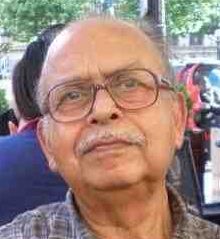
Meeting Ved Mehta

Author: 
Reginald Masssey

Category:

Reginald Massey

Reginald was born in Lahore before Partition. He writes books on various subjects pertaining to South Asia. A former London journalist, he now lives in Mid Wales with his actor wife Jamila. His latest book is Shaheed Bhagat Singh and the Forgotten Indian Martyrs, Abhinav Publications, New Delhi. A member of the Society of Authors, he is a Fellow of the Royal Society of Arts.

Ved Mehta is a celebrated writer, and a man who overcame severe disability by sheer will power.

Born in Lahore in 1934, at the age of four he was blinded by cerebrospinal meningitis. His father, a doctor, was aware that his son had no future in India since most people in India regarded blindness as a curse, a divine retribution for some great sin or crime committed in a past life.

In 1949, Ved was sent to the Arkansas School for the Blind. From there he went to Pomona College in California, a liberal arts institution with a high reputation. Since few books were then published in Braille he needed a fellow student who could read the text books to him. Fortunately, his friend Eugene Rose volunteered to help. Mehta wrote that his friend's readings were so clear that it seemed as if he was "explaining things".

(Rose later became Father Seraphim Rose, a Russian Orthodox hieromonk and a leading figure of the Orthodox Church in USA.)
My Dagger and I

Author: 
Harish Malhotra

Category:

Harish Malhotra, MD, is a diplomat of the American Board of Psychiatry and Neurology, a Distinguished Life Fellow of the American Psychiatric Association, and a clinical associate professor of psychiatry at Rutgers Medical School in Newark, New Jersey. He is the past chair of department of psychiatry of Overlook hospital, Summit. He has been practicing psychiatry since 1977. His book Metaphors of Healing is available from Amazon and Barnes and Nobles, including Kindle and Nook\; see below for an excerpt from this book.

My family lived in Meerut in 1959. I was in ninth grade.

Every year, since the 17th century, Meerut held an annual Nauchandi fair. Whole villages would come from far and wide to attend this event. The town would spend a lot to decorate the place with laces and leaves. People from all over the state would converge, and put up stalls and shops to display their wares. You would see unfamiliar and surprising stuff being sold. For example, there were shops that displayed face masks, beards and wigs, which were not available in town then. I cannot recall any shop in town that sold facemasks, moustaches, and dresses that were used for stage drama.

Train Full of Grapes

Author: 
Harish Malhotra

Category:

Harish Malhotra, MD, is a diplomat of the American Board of Psychiatry and Neurology, a Distinguished Life Fellow of the American Psychiatric Association, and a clinical associate professor of psychiatry at Rutgers Medical School in Newark, New Jersey. He is the past chair of department of psychiatry of Overlook hospital, Summit. He has been practicing psychiatry since 1977. His book Metaphors of Healing is available from Amazon and Barnes and Nobles, including Kindle and Nook\; see below for an excerpt from this book.

In 1955, when I was in the seventh grade, we lived in a town called Aligarh. It was a major town of Uttar Pradesh, seat of Aligarh Muslim University.

As I would step into the bazaar from my home, I would immediately see hawkers with their carts full of fruits. Most of them were selling bananas and guavas. They were the poor man's fruit because people could afford them. Bananas sold for six annas (one rupee = 16 annas) per dozen while guavas sold for four annas per ser (an old measure of weight, about 0.6 kg).

Early days: Jessore 1930s

Author: 
Tapas Kumar Sen

Category:

Tags:

Tapas Sen was born in Kolkata (1934), and brought up in what now constitutes Bangladesh. He migrated to India in 1948, and joined the National Defence Academy in January 1950. He was commissioned as a fighter pilot into the Indian Air Force on 1 April 1953, from where he retired in 1986 in the rank of an Air Commodore. He now leads an active life, travelling widely and writing occasionally.


Editor's note: This is a slightly modified version of article originally appeared on Air Commodore Sen's blog TKS' Tales. It is reproduced here with the author's permission.

I have no recollections earlier than our being in the house (in Jessore) above the Chaurasta or the four-way crossroads.

Actually, it is amazing that I remember anything of Chaurasta at all, as I was really a small guy at that time. I was born in July 1934 and I now know that we left our hired house on the Chaurasta in mid – 1937. I should not really expect any memory of that age at all, but I find that in the rearmost recess of my childhood memory, I have a vivid picture of that house and I can recollect clearly my playful days there.

Tapas Sen. 1935. Jessore

Tapas Sen. 1935. Jessore

A Six-year Old’s Visit to Pabna: 1940

Author: 
Tapas Kumar Sen

Category:

Tags:

Tapas Sen was born in Kolkata (1934), and brought up in what now constitutes Bangladesh. He migrated to India in 1948, and joined the National Defence Academy in January 1950. He was commissioned as a fighter pilot into the Indian Air Force on 1 April 1953, from where he retired in 1986 in the rank of an Air Commodore. He now leads an active life, travelling widely and writing occasionally.

Editor's note: This is a slightly modified version of article that originally appeared on Air Commodore Sen's blog TKS' Tales. It is reproduced here with the author's permission.

My story today is from the memories of a six year old.

Fragmented, somewhat disjointed, but gathered assembled arranged and decorated with fanciful imagination, and then cemented with love. To understand the story, however, the reader would need a few background notes that a six-year old is not in a position to provide. For a few minutes therefore I would have to hip-hop between my ‘me’ of today to the ‘me’ of 1940, as I lay down the back ground, often from hearsay information from an era a decade before I was born.

Background

Averting the Horrors of the 1943 Bengal Famine

Author: 
Tapas Kumar Sen

Category:

Tapas Sen was born in Kolkata (1934), and brought up in what now constitutes Bangladesh. He migrated to India in 1948, and joined the National Defence Academy in January 1950. He was commissioned as a fighter pilot into the Indian Air Force on 1 April 1953, from where he retired in 1986 in the rank of an Air Commodore. He now leads an active life, travelling widely and writing occasionally.

Editor's note: This is a slightly modified version of article that originally appeared on Air Commodore Sen's blog TKS' Tales. It is reproduced here with the author's permission.

Planting our crops

We had just moved into our new and half-finished house at Himaitpur. It was early 1943.

The riversides of Himaitpur were full of Jute growing to its full height. The flood plains along the river were a very fertile tract. The land was of course sandy and loamy\; not quite fit for the cultivation of fine varieties of rice. However, the farmers had the choice of sowing jute, sugarcane, or the aus variety of rice. Some of them also experimented with maize at times. These flood plains, known as char-land were fit only for single or double cropping while the land further inland regularly produced three crops a year.

Getting into the Armed Forces Academy

Author: 
Tapas Kumar Sen

Category:

Tapas Sen was born in Kolkata (1934), and brought up in what now constitutes Bangladesh. He migrated to India in 1948, and joined the National Defence Academy in January 1950. He was commissioned as a fighter pilot into the Indian Air Force on 1 April 1953, from where he retired in 1986 in the rank of an Air Commodore. He now leads an active life, travelling widely and writing occasionally.

Editor's note: This is a slightly modified version of article that originally appeared on Air Commodore Sen's blog TKS' Tales. It is reproduced here with the author's permission.

Passing the written test

In 1949, my first concern was getting selected for the Inter Services Wing of the Armed Forces Academy (ISW/AFA)

The syllabus for the examination, conducted by the Union Public Service Commission (UPSC) for entry into the ISW/AFA was limited\; a total of three papers, one each on English, Mathematics and General Knowledge / Current Affairs.

The Ghost – in Lucknow

Author: 
Anand

Category:

Anand has been a print and broadcast journalist in Canada. His translations of Hindi fiction into English have been published by Penguin India and Rupa Books. He has also translated Canadian fiction writers, including the 2013 Nobel Prize winner Alice Munro into Hindi. He divides his time between Montreal, Canada and Lucknow, India.

The Ghostwas a newspaper that I wrote, published and circulated. Add to it the job of stencil cutting for printing on a cyclostyle machine, and you have the ideal candidate for the position of chief cook and bottle washer.

The place of its birth was Lucknow, the ‘City of Nawabs' 500 km southeast of Delhi, and the capital of Uttar Pradesh, the most populous state in India. Renowned as a centre of language, poetry and fine arts, Lucknow was also a centre of higher education, with University of Lucknow being a top-rated university in India. Formed in 1920, the University included the nationally renowned King George's Medical College and Isabela Thoburn (IT) College for women. The University had been a hotbed of radical protest during the national movement under the British raj. The University's good reputation in the fields of social sciences and humanities lasted until the 1960s, when agitations by self-serving student leaders brought the academic activity to a standstill for some time.

A Journey Through Life-1

Author: 
Jatinder Sethi

Category:

Jatinder Sethi was born in Lyallpur, now Faislabad, in pre-Independence India. He finished his M.A. (English) from Delhi University in 1956, and went off to London to study Advertising in 1958. He passed his Membership Exam of The Institute of Practitioners in Advertising (M.I.P.A) in1965, and joined Rallis India in Bombay. Later, for over 20 years, he worked for the advertising agency Ogilvy &amp\; Mather. Now retired, he helps his son in his ad agency in Delhi.

Editor’s note: This is the first part of a three-part story. The second part of the story is available here (under preparation), and the third part is available here Under preparation).

Preface

This is a story of a part of our journey through life. It is a journey of a couple, from student days through five decades of life together and work, and finally a retired life.

This part will only highlight the adventure of a young, newly married couple, who travelled with hardly any money in the pocket. And landing in London without knowing a soul in that foreign land. It is more a journey through life of two people, who fell in love, without realizing or knowing what the future will unfold. Or hold. Well, "Love is blind", and we were blind. But we will not do it again.

A Journey Through Life-2

Author: 
Jatinder Sethi

Category:

Jatinder Sethi was born in Lyallpur, now Faislabad, in pre-Independence India. He finished his M.A. (English) from Delhi University in 1956, and went off to London to study Advertising in 1958. He passed his Membership Exam of The Institute of Practitioners in Advertising (M.I.P.A) in1965, and joined Rallis India in Bombay. Later, for over 20 years, he worked for the advertising agency Ogilvy &amp\; Mather. Now retired, he helps his son in his ad agency in Delhi.

Editor's note: This is the second part of a three-part story. The first part of the story is available here, and the third part is available here Under preparation). Part 1 ended with the Sethis leaving Cochin (now Kochi) on a ship for Europe.

Preface

This is a story of a part of our journey through life. It is a journey of a couple, from student days through five decades of life together and work, and finally a retired life.

The sea voyage in a lower deck

Pages

Subscribe to RSS - Life Back Then